
DUTCH GUM®, a functional food ingredient made from coffee pulp. PectCof, The Netherlands
PectCof is the producer of “Dutch Gum®,” a food emulsifier and stabilizer made from pectin and proteins extracted from coffee pulp. The concept for PectCof originated in 2011 at Wageningen University in the Netherlands, where Rudi Dieleman and three other students proposed using coffee pulp as a functional food ingredient during a competition. Their innovative idea won the competition, earning them a loan from the business incubator StartLife, which enabled them to establish PectCof in 2012.
By 2016, Rudi was the sole remaining founder, facing an empty bank account. To keep himself and the company afloat, he worked part-time jobs until two business angels stepped in with investments. Their support allowed him to develop the necessary technology to create a marketable product. At the end of 2021, two venture capital firms joined forces with PectCof. As of late 2024, the company is undergoing another round of financing.
A few weeks ago, I had the pleasure to talk with Rudi Dieleman, the “survivor” and driving force behind the company on a mission.
Rudi, when you and your fellow campaigners founded PectCof in 2012, it was quite early stages for the very idea of upcycling a coffee by-product. What gave you the initial idea at that time?
It was definitely the early stages! One of my colleagues at Wageningen University at the time, Andres, is from Colombia. His family owns an analytical laboratory in Bogotá, where a client once requested an analysis of coffee pulp. While the pulp didn’t contain the specific phenolic compound the client was looking for, Andres noticed some intriguing spikes in the spectrum that caught his attention. Although he wasn’t certain what those spikes represented — perhaps proteins or polyphenols — he shared his findings with us, saying, “Guys, we could do something with this.” Given the vast biomass generated by Colombian coffee production, we realized this could potentially be something both economically and environmentally viable, even though we weren’t sure what it would become.
That’s how it all began—very basic. Eventually, we pitched the idea of extracting pectin from coffee and founded PectCof. However, since we needed to finish our studies, it wasn’t until early 2016 that we were able to run PectCof full-time.
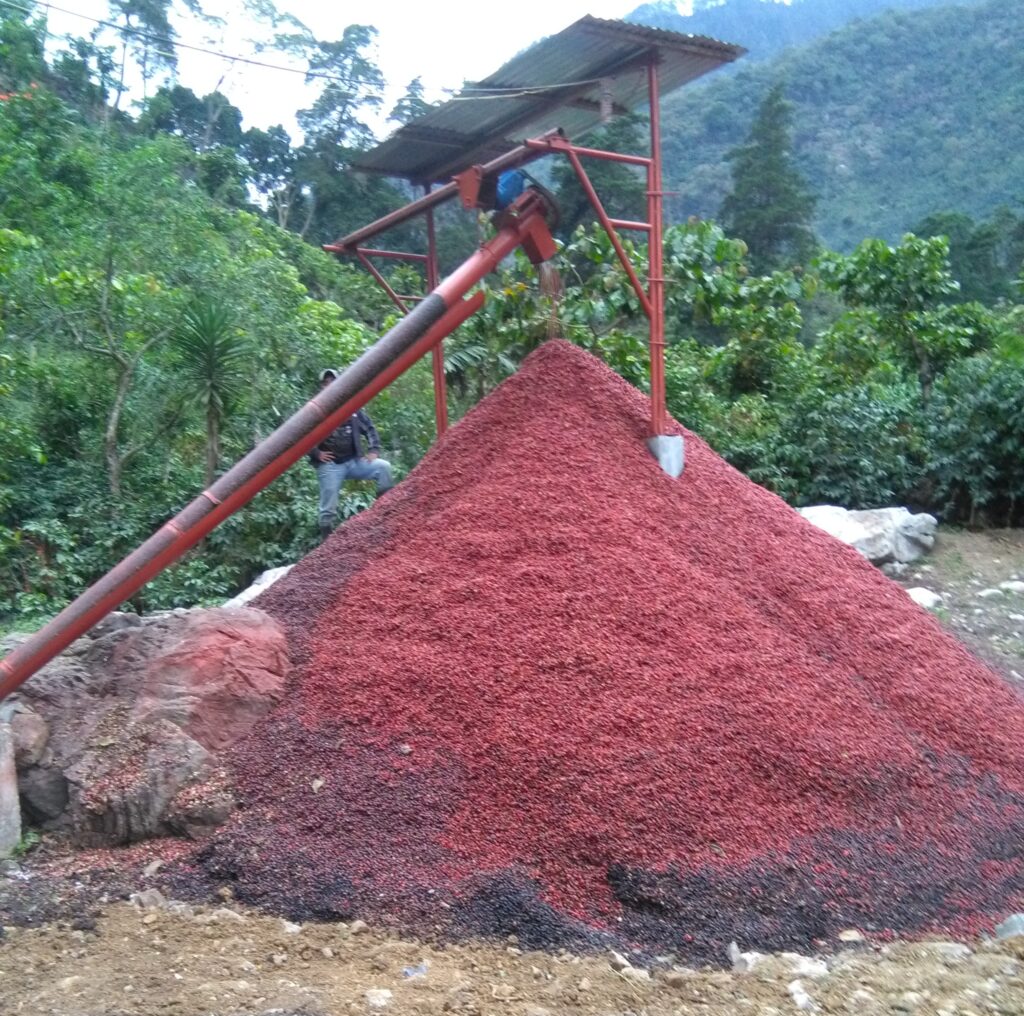
Coffee pulp, the raw material for PectCof´s Dutch Gum® (source: Dr. Hans-J. Langenbahn; picture taken at “La Bolsa”, Guatemala)
So, your idea was to extract pectin from the coffee pulp?
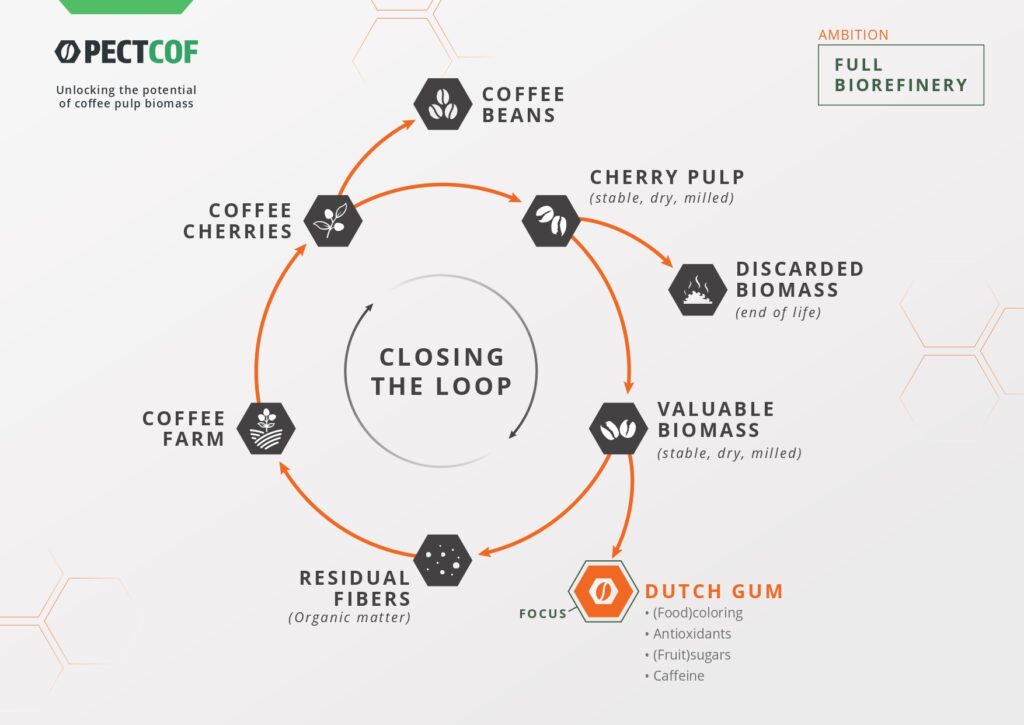
That’s correct—it all started with pectin, which was one of the spikes I mentioned earlier. Today, our focus remains primarily on pectin, with a smaller portion of proteins and other components. However, unlike in the early days, we now see ourselves as biorefinery technology developer. This shift reflects our broader vision: we aim to extract additional valuable compounds from coffee pulp, such as natural colors, fruit sugars, natural caffeine, water-binding fibers, antioxidants, and more from the pulp.
Who actually develops your biorefinery technology?
Andres is the “godfather” of the technology; he also wrote our patents. Over the years we have been fine-tuning it quite a bit, because we’ve gradually built up a lot of know-how. We still do a lot of analysis, and we work closely together with Wageningen University, especially with their food chemistry, food processing and food quality departments.
Additionally, we are involved in development groups to deepen our understanding of the technology, explore potential applications for our products, and determine the best approach for bringing them to market.
Let’s switch from the technical to the biochemical part of your business. Does pectin from coffee pulp have the same properties as pectin from apples or citrus fruits?
No, it has different functionalities. While it does gel, it’s not as effective as pectin derived from apples or citrus fruits. Because of this, we developed the brand name Dutch Gum®. For our customers, the term “gum” is more associated with emulsification and stabilization—functions that serve as alternatives to gelling, which is the primary role of traditional pectin. Dutch Gum is our first product, but it’s just the beginning. Revenue from Dutch Gum will support the continued development of our biorefinery technology, paving the way for the creation of new products in the future.
What would be a typical application of Dutch Gum®?
We are currently focused on three main applications: plant-based ice cream, high protein bars, and vitamin gummies. We use it as an emulsifier/stabilizer (first extract) and binder/texturizer (second extract) instead of a gelling agent. It will basically substitute Locust Bean Gum (LBG), which is an extract from the seeds of the carob tree and a widely used stabilizing agent in the food industry.
What does Dutch Gum® consist of?
75% fiber, including the pectin fraction, 7% protein, 3% sugars as well as some polyphenols, minerals and moisture.
What is the advantage of Dutch Gum® over LBG?
One advantage is that it improves the melting profile of ice cream. For example, ice cream with this additive melts more slowly compared to those using current market alternatives.
Additionally, Dutch Gum® enhances flavors. For instance, when added to strawberry-flavored ice cream—whether or not it contains actual strawberry pieces—it boosts the strawberry taste, resulting in a richer flavor. This allows manufacturers to either enhance the flavor of the ice cream or maintain the same flavor while reducing costs by using less flavoring.
The same effect has been observed with cacao, which is currently quite expensive. We are running experiments and already see a noticeable flavor enhancement. We are now working on calculating the potential savings, such as for chocolate producers, without compromising the flavor of their products.
As a manufacturer of ice cream or chocolate, would those savings outweigh the cost of having to buy your new Dutch Gum®?
Yes! But there is something else – 70 or 80% of LBG is produced in the mediterranean region, mainly Italy, Spain, Portugal, but due to Real Estate activities we see a decrease in the number of carob trees, which means a slow but steady reduction in the LBG supply. This means, it has to be replaced by something else…
Can the Dutch Gum® be used in drinks or juices too?
Absolutely! For instance, it can stabilize fibers. Take an unfiltered orange juice; the fibers always settle at the bottom of the bottle. If you stabilize them in the matrix, each sip will have the same amount of fiber. In drinks where you have water and flavor-bearing oils like in a Fanta, the protein emulsifies the oil, and the pectin stabilizes the oil throughout the drink.
And all this with extracted pectin and protein from coffee pulp! That’s great news! But mentioning the pulp: which kind of pulp do you use to make your Dutch Gum®?
We use the dried pulp from wet-processed Arabica coffee. The drying process begins immediately after pulping, and once it is complete, we grind, pack, and ship the pulp. We do not use the husk or biomass from naturally processed coffees because of degradation. During sun drying, enzymes break down the molecular structure, resulting in a raw material that is unsuitable for our extraction process.
Talking about drying: proper, food grade drying of the wet pulp is crucial for your purposes. How do you manage this step?
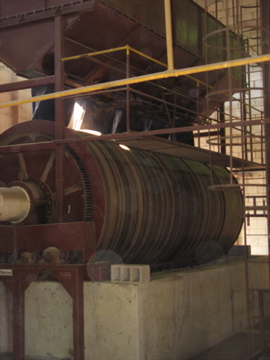
Guardiola (source: Dr. Hans-J. Langenbahn; picture taken at Fazenda Cachoeira da Grama, Brazil)
In Colombia and Costa Rica, we use “Guardiolas”, mechanical drum dryes, which work very well for drying the pulp. However, we only use them at the beginning and end of the harvest season because, during the peak season, they are primarily needed for drying parchment coffee.
Drying the pulp is much faster than drying parchment coffee, which means we require significantly less fuel. We dry the pulp to below 10% moisture content, and although the drying time varies based on factors like temperature and volume, it always takes less than 24 hours. An added benefit is that the drums are cleaner at the end of the pulp drying process than after drying parchment coffee!
Drying the wet pulp in “Guardiolas” is a new thing to do, at least to my knowledge. Are there any challenges?
There are some, sure! The main one, however, is education. Most mills and co-ops have never done this before, so it requires a lot of talks and discussions. As our knowledge grows, it becomes a mutually beneficial learning process.
How do you find your pulp suppliers?
That’s the easiest part of all – people reach out to us! From there, we begin the process of determining whether we can collaborate. One of the key factors, aside from food safety and having reliable partners, is volume. For example, to run our demonstration plant, we need 350 tons of pulp. This requires us to work with larger coffee producers or co-ops. The reason for this high volume is the pulp-to-Dutch Gum® ratio, which is 10:1.
What are further criteria in the selection of a valuable pulp for you?
First, we assess the pectin and protein levels. If they are high enough, we then check for pesticides, heavy metals, microorganisms, and other contaminants to ensure their levels are within acceptable limits. This is crucial because we import the pulp into the EU, and without meeting EU safety standards, we cannot import it. Additionally, we ensure the biomass is homogeneous.
How do you fix the price for dried pulp, or in your words, biomass?
We reach out to multiple suppliers, analyze their samples, and determine if they can provide the required volume, typically one or two containers. If we receive a reasonable quote, we proceed with the contract. It’s that simple.
I’m asking this question because there is still no quality/price correlation for cascara or dried pulp. There is no grading system, there are no cupping standards etc., things that are urgently needed for trading this new commodity.
I totally agree. Prices are all over the place. I have seen prices for pretty much the same quality level going for less than 1 dollar per kg up to several dollars per kg. The prices are really dependent on what the producer thinks his/her biomass is worth.
There are now also middlemen who buy the biomass from producers and sell it. This of course makes the raw material more expensive and consequently the final product too.
Do you think that upscaling by-products will actually bring additional income to coffee producers?
Definitely! Look, coffee trees bear cherries, not beans. Cherries are the crop! Why shouldn’t a farmer get the value for his whole crop instead of only 20%?
The only thing that we have to keep in mind is the fact that there is not yet an established market for upcycled coffee by-products. But I’m optimistic.
And by drying the pulp, for instance, the coffee producer adds value.
Right! The farmer or the co-op adds value; we add value too; we want to get paid for our products, and the same applies to the farmer or co-op. It’s very simple.
How important are the flavors of the dried pulp for you?
Actually, we have to get rid of flavors. From the perspective of product development, our products have to be odorless, tasteless, and very functional.
I see; because this makes it possible to add your Dutch Gum® to another food product without interfering with other flavors. But as your Dutch Gum is an extract, does it have novel food status?
Yes! We are currently in the process of seeking approval from EFSA, and we’re already well advanced. We expect to receive the opinion from the scientific committee by the end of the year, after which it may take another four to seven months for official approval. A couple of months ago, we received Self-Affirmed GRAS (“Generally Recognized As Safe”) status in the US, allowing us to start selling our Dutch Gum® there. Within the EU, we have already sent samples to companies for testing in their food products.
If you would get a request for a huge amount of Dutch Gum® one day, could you produce it? Or would scaling up be a problem?
It wouldn’t be a problem for us. We have actually already reached our capacity, and because of that we’ve outsourced a part of our production to a manufacturer in Eastern Europe. And that is something we continue to do. That’s our strategy to deal with volume.
And you could do this for everything you want to extract in the future like colours, polyphenols, caffeine etc.?
Absolutely! We already did a couple of subsidized programs to check the feasibility of all of these side streams. I do have a complete picture of where to go first, what to do, which market is the right one for us, but for the moment we want to focus on the production and distribution of Dutch Gum®. We’re a small team with a core of only five people.
Technically we are ready to move to the next step, but as you know, if you extract natural caffeine, water binding fiber or whatever from a new source like coffee pulp, it requires regulatory approval. You have to prove that your products are not a health risk, and this takes time and a lot of effort, even if the process is easier now that cascara as a whole is already approved in the EU, at least for limited uses (beverages). It’s not easy to get a new food product or ingredient to the market.
If someone wants to visit you, where can they find you?
Well, there are three options. In The Netherlands I might be in one of our two locations: either in Venlo, where we have our main office and where we do the technology developments, or in Harlem, where we do the application development. Sometimes I´m also with our partner in Eastern Europe who is doing the production. It’s not too complicated to find me…
Rudi, let’s pause our discussion here and resume in 5 years! It would be super exciting to see what will happen in those years. Thank you so much for your time!