From Waste to Taste – A Food Ingredient Made from Spent Coffee Grounds

Connecting Grounds is a startup that was launched in Aarhus, Denmark’s second largest city, under the adverse circumstances of the Covid pandemic. The company, although quite small in size, has the potential to make its mark in the coffee byproducts upcycling movement.
It requires considerable confidence and a great deal of curiosity to start a business in times of great isolation and uncertainty, and Giulia Francesca Marchetti, co-founder of Connecting Grounds, is quite confident in herself, her fellow entrepreneurs and the future:
“Me and four other people, which I did not know at the time, responded to a question on a Facebook group, where a woman wanted to do something with spent coffee grounds but didn’t quite know how to make a business out of it and was looking for some external help,” says Giulia. “Me and the others found that super exciting and commented on her post. That led to lots of meetings and brainstorming sessions, and yes, that’s how it all started. I stumbled into it more by chance.”
Connecting Grounds was eventually founded in 2021. Of the 5 original founding members, 2 remain: Giulia (CEO) and Klaudia Laczi (COO). They are supported by a business advisor and numerous interns. “Interns are essential for us at the moment; we couldn’t do it without them,” says Giulia.
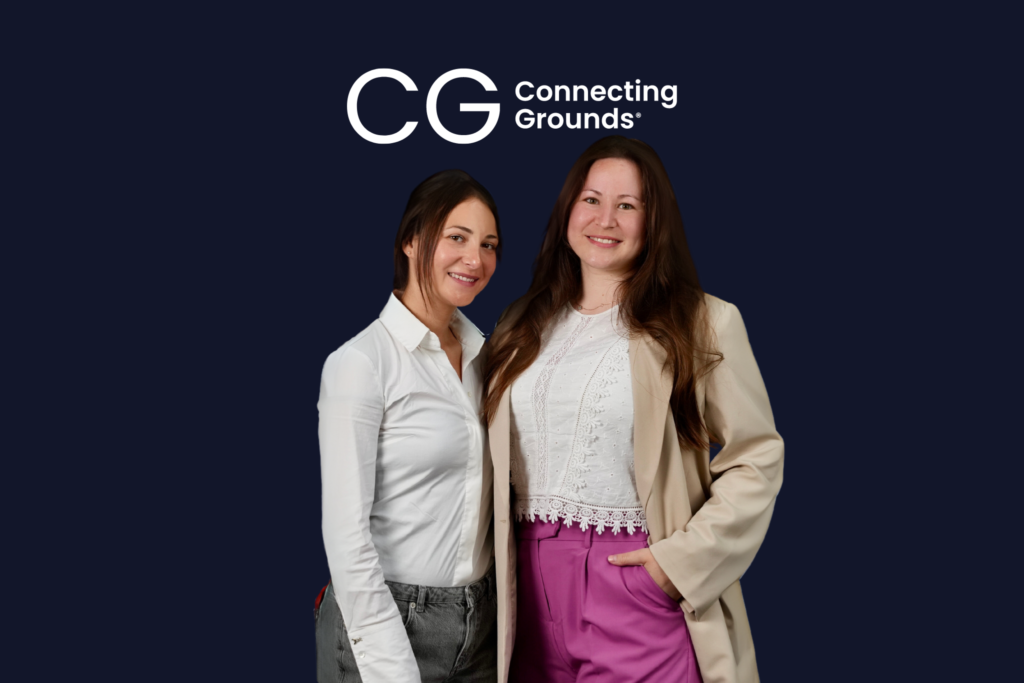
Connecting grounds: Giulia Francesca Marchetti (left) and Klaudia Laczi (right)
What surprised Giulia and her colleagues most about spent coffee grounds was the high nutritional value that remains after the coffee has been brewed. In light of this, it was only natural to wonder how these valuable nutrients could be used as a food additive. Fortunately, there were already some inspiring pioneers such as Kaffe Bueno in Denmark or GroundUp Eco-Ventures in Canada to look to for inspiration.
Something else that was very important initially for setting up the company was the local culture: “We were very lucky to set up our company in Denmark. The country is open to startups and the entire community around entrepreneurship. There’s also a lot of focus on sustainability. All of this helped us tremendously from the very beginning,” says Giulia.
Due to the high level of competition in the food sector, the Connecting Grounds team quickly discarded the idea of producing consumer products such as fiber or protein bars. After numerous tests and devouring a great deal of scientific literature, it was determined that the better strategy was to produce food ingredients whose final use could be decided by food manufacturers themselves.
Finally, Coffee Base was developed. Coffee Base is a multifunctional ingredient that can be used in ready-made and snack products, whether as an addition of fiber, protein, caffeine, color or coffee flavor; it is also suited as an ingredient in gluten-free flours. “We have tested our Coffee Base in baked products, like bread or focaccia, pastries and much more. Based on those results, we built profiles that we send to potential customers and say ‘Look, these are the possibilities; try it out’,” says Giulia.
Most companies that upcycle coffee grounds first extract the valuable coffee oil. It is increasingly being used in skin and sun protection creams, due to its skin-protecting properties, but is also suitable for the production of biodiesel, for example. Connecting Grounds skips this extraction process in favor of keeping the oils. As Giulia explains: “The reason for it is because we see so much value in keeping the grounds as they are. If we take away the oils, we are losing a lot of the aromas and a lot of the properties of the final base. We try not to process to the grounds much which, of course, comes with a lot of challenges like the cleaning of the machines, for example.”
As is the case, for anyone who upcycles spent coffee grounds, the drying process is one of the biggest hurdles for Giulia and Klaudia to overcome. In the meantime, they have identified suitable drying equipment options from Danish and German manufacturers. However, the high upfront investment costs have temporarily compelled them to dry their coffee grounds using an industrial bakery oven.
Grinding the coffee grounds is another hurdle as the particles, which are only 500 micrometers in size, tend to get stuck everywhere in the grinder and hinder the grinding process; but the team is now closer to solving this problem.
Circularity is of course a top priority at Connecting Grounds. The basic idea is to collect the coffee grounds from partners like Europa Kaffe & Te and Cafe Nifty, process and sell them to the same partners for various uses in cookies, muffins, and other treats. Roasters are also approaching the start-up, as they are increasingly being asked by customers: “What do I do with all these spent coffee grounds? We see an increasing shift here in Denmark. Consumers don’t want waste simply becoming disposed anymore,” says Giulia. “And that’s exactly what we want to see too: waste isn’t waste anymore! And the great thing, at least in our case, is that everyone involved is working hand in hand. That’s very motivating.”
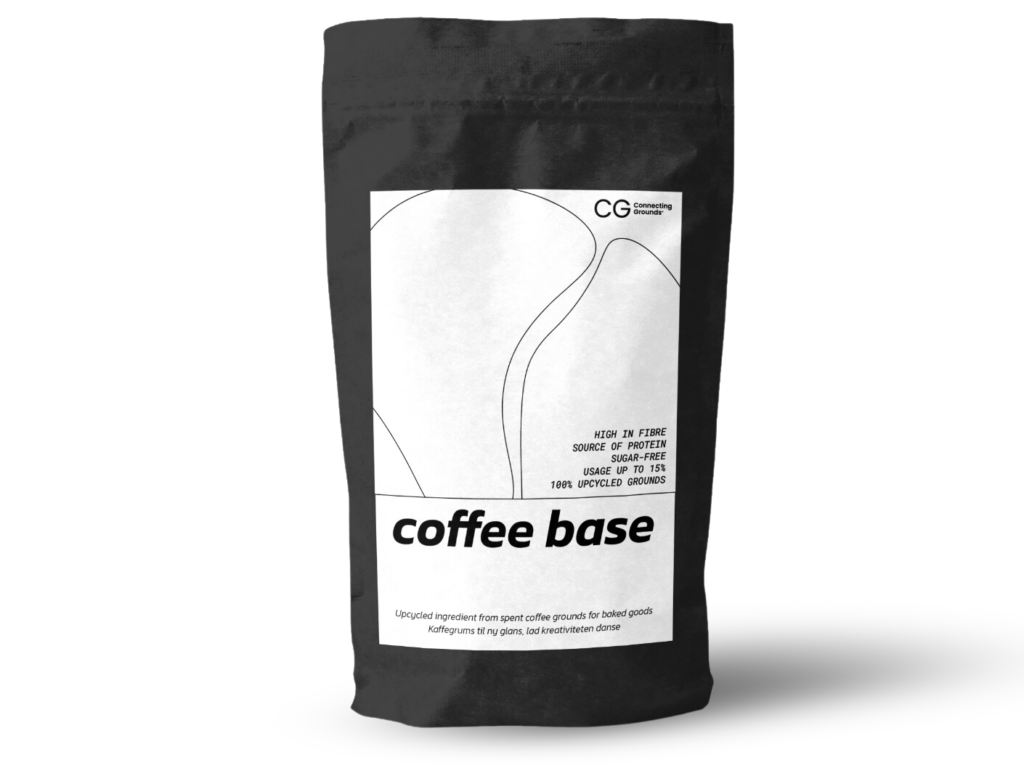
Coffee Base: Made from spent coffee grounds
At Connecting Grounds, “taste” is actually made from “waste”! Up to 15% of a baked product’s total ingredient volume can be substituted with Coffee Base, which is a quantity that can sustain a business if the sales volume is high enough.
Before the conversion process can begin, the coffee grounds must first be collected—a challenge that Giulia and Klaudia are still addressing. Currently, they collect the coffee grounds from their partners every three days. The grounds are stored under cool conditions at the partner locations until pickup. Once delivered to Connecting Grounds, the coffee grounds are dried and transformed into Coffee Base. The resulting Coffee Base is then returned to the partners.
Giulia recognizes that their current collection logistics are not sustainable in the long term. She explains, “The next step will be implementing ‘reverse logistics,’ which involves engaging our partners’ suppliers in the collection process as much as possible. After a preset period, they will deliver the coffee grounds to us, significantly reducing the need for us to drive around. However, since these suppliers operate food trucks that must ensure food safety for all their cargo, we need to convince them that coffee grounds are not contaminating waste but rather raw materials for creating new food or food ingredients. This shift in mindset will take time,” Giulia acknowledges.
In addition to this business with “coffee grounds producers”, Connecting Grounds also supplies smaller companies such as bakeries and a vegan burger manufacturer that adds the Coffee Base to its plant-based patties.
While Connecting Grounds’ small customer base is not yet enough for significant growth, the company has established a solid foundation, with plenty of ideas for expansion and steadily increasing recognition. If the unpredictable landscape of small business start-ups were likened to the winds of the Danish North Sea coast, this small company with big ambitions has found a safe harbor for now. Thanks to Innofounder, a start-up grant, Connecting Grounds is financially secure until October. Beyond that, the entrepreneurial journey is expected to face stronger headwinds. However, Giulia and Klaudia are already preparing “wind turbines,” metaphorically speaking— strategies designed to withstand challenges and turn uncertainty into opportunities, aligning with the very essence of innovative ventures.
Additional resource:
Applications of Compounds from Coffee Processing By-Products