
Transforming spent coffee grounds into chocolate. SOI, Japan

Hello Kyoko, We’ve known each other for a while now, and during our last conversation, we agreed it’s time to share what SOI, the company you work for, is doing with spent coffee grounds. Before we dive into your innovative products made from upcycled spent coffee grounds—most notably your famous COLEHA chocolate bar—could you start by providing our readers with some background information about the company?
Absolutely! SOI was founded in 1984 by Reizaburo Ishigaki, who held a master’s degree in fermentation science. He is the father of our current CEO, Dr. Tetsuji Ishigaki. Our mission as a company is to transform organic waste into delicious food products, revolutionizing how people perceive both food and waste.
The Ishigaki family’s legacy in fermentation dates back to 1739, providing us with centuries of expertise in turning waste into valuable products. Dr. Ishigaki’s ‘UPTECH‘ concept reflects our commitment to zero waste, ensuring that every part of a resource is utilized through our time-honored fermentation techniques. Nothing goes to waste.
Our main office is located in Numazu City, Shizuoka Prefecture, approximately 100 kilometers west of Tokyo and near Mount Fuji. In March 2024, we opened a new upcycling factory in Tokyo, conveniently located near Haneda International Airport.
As one of the co-founders, I oversee marketing and various other aspects of the business. Together, we are a dedicated team of professionals passionate about our mission.

Dr. Tetsuji Ishigaki. (left), Kyoko Terada (right)
One of SOI´s goals is to be a zero waste company…
SOI has been a zero-waste company from the very beginning, thanks to our fermentation techniques and our rich roots in the Japanese philosophy called, ‘Mottanai’.
The term “Mottainai” conveys a sense of regret over waste, going beyond simply avoiding waste. It embodies a profound respect for resources, valuing everything, and ensuring that nothing is discarded unnecessarily. In Japan, this mindset is instilled from a young age, teaching people to appreciate the intrinsic value of all resources.
At SOI, we live by this philosophy through a holistic approach grounded in several key principles:
Resource efficiency: We utilize every part of a plant or fruit, ensuring nothing goes to waste and maximizing the value of each resource.
Respect for nature: By fully using every element of a plant, we honor its existence and the value it provides.
Creative consumption: We innovate ways to repurpose traditionally discarded parts, transforming waste into valuable materials.
Sustainable practices: By maximizing the use of each resource, we reduce waste and minimize the need for additional inputs.
This philosophy reflects a way of life that fosters respect for the environment and the resources consumed. Our ultimate goal at SOI is to see our technology adopted by factories worldwide, creating a more sustainable future for all.
On a related note, SOI is also interested in partnering with coffee farmers to co-create new coffee flavors through fermentation.
Upcycling without any leftovers sounds like an ideal situation!
Indeed! And it´s doable — in our case, as we work with fermentation, there is barely any waste left when we are finished.
Let’s dive a bit deeper into your fermentation process…
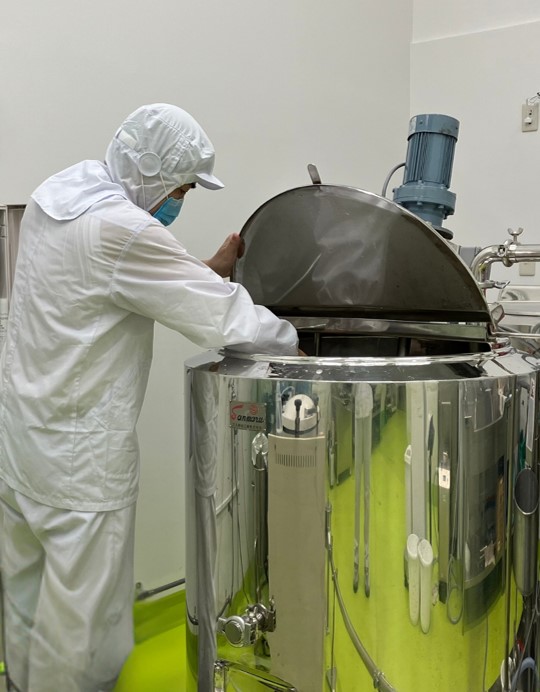
Unfortunately, I can’t share the specific details of our fermentation process — sorry for that. However, the basic steps are quite straightforward. When we receive wet spent coffee grounds, we grind them and initiate fermentation using koji. Koji is a type of mold commonly used in traditional Japanese food fermentation. Once the fermentation process is complete, we halt it and the transformed grounds, which now have a paste-like consistency, are sent to our partners. They use the paste to create products like our COLEHA bar, cookies, and more. We also collaborate with baristas who use the fermented grounds to craft innovative coffee drinks.
A well-known example would be Taka Ishitani who used your paste at the World Barista Championships in 2022.
Yes, he actually did. And he placed 4th! He is truly amazing!
Ok, good to know! Speaking of your COLEHA bar—you offer it with four different sugar levels, and I have to admit, each one truly tastes like chocolate!

COLEHA chocolate bar, SOI, Japan
Thank you. With our process, we’re able to make spent coffee grounds delicious
A process that you can’t fully share the details of…?
That’s right—it’s our secret!
In 2022, Forbes magazine published an article about your company. Can you share the impact such high-profile publicity had on your business?
Yes, that was a real game-changer for us. Suddenly, we started receiving inquiries from all over the world. Unfortunately, this happened during the pandemic, which created some challenges. Since our products aren’t cheap—due to the complexity of our processing and our relatively low production volume—they were too expensive for many customers at the time.
This experience prompted us to take a new direction. Today, we see ourselves more as a fermentation technology consulting company rather than solely a producer of upcycled spent coffee ground products. We now focus on advising companies that need support with fermenting various organic waste materials, primarily using koji but not exclusively. Additionally, we provide the necessary technology to support their efforts.
Can this fermentation process be used for different kinds of organic waste?
Yes, absolutely! From tea leaves to onions, cabbage, or even leftovers from orange juice production—we can ferment almost anything, as long as it’s plant-based.
Is this related to the opening of your new, smaller production facility in Tokyo?
Exactly! With the growing focus on Sustainable Development Goals, upcycling has become a popular trend in Japan. New types of products tend to gain traction in big cities rather than in rural areas, which is why we chose to establish our upcycling factory in Tokyo. To keep costs manageable, we opted for a smaller facility designed more as a pilot production site than a full-scale manufacturing plant. At around 95 square meters, it’s compact but aligns well with Tokyo’s standard for space efficiency.
And this new production facility is in a strategically interesting location…
Yes, we’re located in Ota, home to Haneda International Airport. This makes us easily accessible to both domestic and international business and private customers.
In the food industry, fermentation is becoming increasingly important, especially for functional food ingredients. However, scaling up is often challenging due to two factors: fermentation is expensive, and it takes time. With that in mind, how long does your koji fermentation process take?
Our fermentation process is significantly faster than traditional methods, typically taking only a few days. We are currently developing and refining a large-scale, low-energy fermentation system that is both simple and reliable. As a fermentation technology company, we bring the expertise and advanced technology needed to streamline the process.
In addition, we’ve partnered with larger companies that generate significant amounts of organic waste or by-products, which we aim to optimize for upcycling.
While our process is efficient, it doesn’t substantially increase production costs. The primary expense lies in the specialized knowledge and technology we provide.
What’s next? I assume your pilot plant will eventually become too small.
Exactly! We’ve already given this a lot of thought. From an environmental perspective, it doesn’t make sense to ship our COLEHA bar and other fermented products worldwide. Our goal—perhaps even our dream—is to establish fermentation facilities in various countries, enabling local production. Spent coffee grounds and other organic waste are widely available everywhere, making this approach a natural fit. We would license our technology and platform while providing the necessary expertise to support these facilities.
Where can people outside of Japan learn more about SOI?
We are preparing to launch a bilingual website (Japanese and English) this fall, with an online store to follow in early 2025. This will be a major step in sharing our mission and innovations globally.
We also have two Instagram Channels: https://www.instagram.com/soi_inc and https://www.instagram.com/up0tech/.
Our products and technology are already designed for the international market, and we plan to showcase them at overseas exhibitions. Since 2022, we’ve been supplying the cosmetics industry with ingredients like hand cream and balm made from upcycled coffee grounds. These products are available for purchase through our partner’s online store.
We are also able to develop ingredients that can serve as alternatives to cacao in chocolate production. With the increasing cost of cacao, we believe these products will meet a growing market demand.
Kyoko, thank you for your time, and good luck!
Thank you — it was a pleasure. We would be delighted to welcome you to our facility!