
NEW PRODUCT / SOLUTION
Vegan leather
APPLICATION SECTOR
Fashion
VALORIZED OUTPUT
Coffee pulp and mucilage
TRL
Deploy
CONTEXT
Global
SDG


VALUE CHAIN AREA
Every year, large quantities of waste are generated during coffee processing, particularly coffee pulp, which accounts for approximately 39–43% of the total weight of the coffee cherry. Based on 2022/2023 global production figures, the Coffee Development Report 2022–2023 (p. 110) estimates that 5.72 million tonnes (wet weight) and 1.09 million tonnes (dry weight) of coffee pulp are generated annually. In many coffee-producing countries, the pulp is often discarded, causing serious environmental problems: it pollutes the soil and water, produces unpleasant odours, attracts insects and promotes the spread of pathogenic microorganisms.
However, thanks to its rich composition of natural fibres such as cellulose, pectin and hemicellulose, coffee pulp is attracting attention as a valuable raw material for the development of sustainable materials. One particularly promising use is its transformation into a plant-based alternative to leather. Through a fermentation process involving specific bacteria, the pulp can be converted into bacterial cellulose, a gelatinous substance that, once dried, takes on the appearance and texture of leather. With just 200 grams of coffee pulp, it is possible to produce approximately one square metre of cellulose sheet.
This bio-based leather is completely biodegradable, non-toxic and highly malleable, offering an eco-friendly and cruelty-free alternative to traditional leather. Given the growing demand for sustainable and ethical fashion, bacterial cellulose derived from coffee waste is becoming an attractive solution. In addition, to improve its aesthetic appearance, natural dyeing techniques are being studied, such as the use of coffee itself, to give this material a distinctive and environmentally friendly finish.
Source:
- Kim, H., & Kim, H. R. (2022). Production of coffee-dyed bacterial cellulose as a bio-leather and using it as a dye adsorbent. PLoS ONE, 17(3), e0265743. https://doi.org/10.1371/journal.pone.0265743
- Marín-Tello, C., Zelada-Castillo, L., Vásquez-Arqueros, A., Vieira, A., & Siche, R. (2020). Coffee Pulp: An Industrial By-product with Uses in Agriculture, Nutrition and Biotechnology. Reviews in Agricultural Science, 8, 323–342. https://doi.org/10.7831/ras.8.0_323
- Mutuku, M., Ombui, J., & Onyuka, A. (2020). Assessment of coffee pulp as a potential source of tannins for leather processing. Textile & Leather Review, 5, 132–146. https://doi.org/10.31881/TLR.2021.31
- Sommano, S. R., Jantrawut, P., Sangta, J., Chanabodeechalermrung, B., Sunanta, P., Bakshani, C., & Willats, W. (2023). Utilization of coffee pulp for the production of sustainable cellulosic composite and plant-based hydrogel as a potential human wound dressing. Food Structure, 37, 100347. https://doi.org/10.1016/j.foostr.2023.100347
DESCRIPTION


IMPACTS
The idea of transforming coffee pulp into bacterial cellulose (BC) for use as bio-leather is innovative, but several obstacles limit its adoption on a large scale. The main challenge lies in managing large-scale production, as fermentation requires controlled environments in terms of temperature, pH and oxygen. These environments are expensive and difficult to manage on a large scale, which affects the quality of the final material.
Secondly, production costs remain high, primarily due to the time-consuming fermentation process and the energy required to dry the water-rich cellulose. While the raw material (coffee pulp) is inexpensive, the process is not yet cost-competitive with conventional leather or synthetic alternatives. BC also has limitations related to the material itself. It is not naturally waterproof or gas-resistant, often requiring additives or coatings which can reduce its sustainability.
Contamination risks during fermentation are another concern, particularly when working with untreated agricultural waste, as this requires rigorous quality control.
Finally, despite promising laboratory research, commercial applications are still rare and further innovation is needed to make this process viable on a large scale, as well as to analyse the recyclability of the product at the end of its life.
CHALLENGES AND LIMITS

EXAMPLES OF APPLICATION
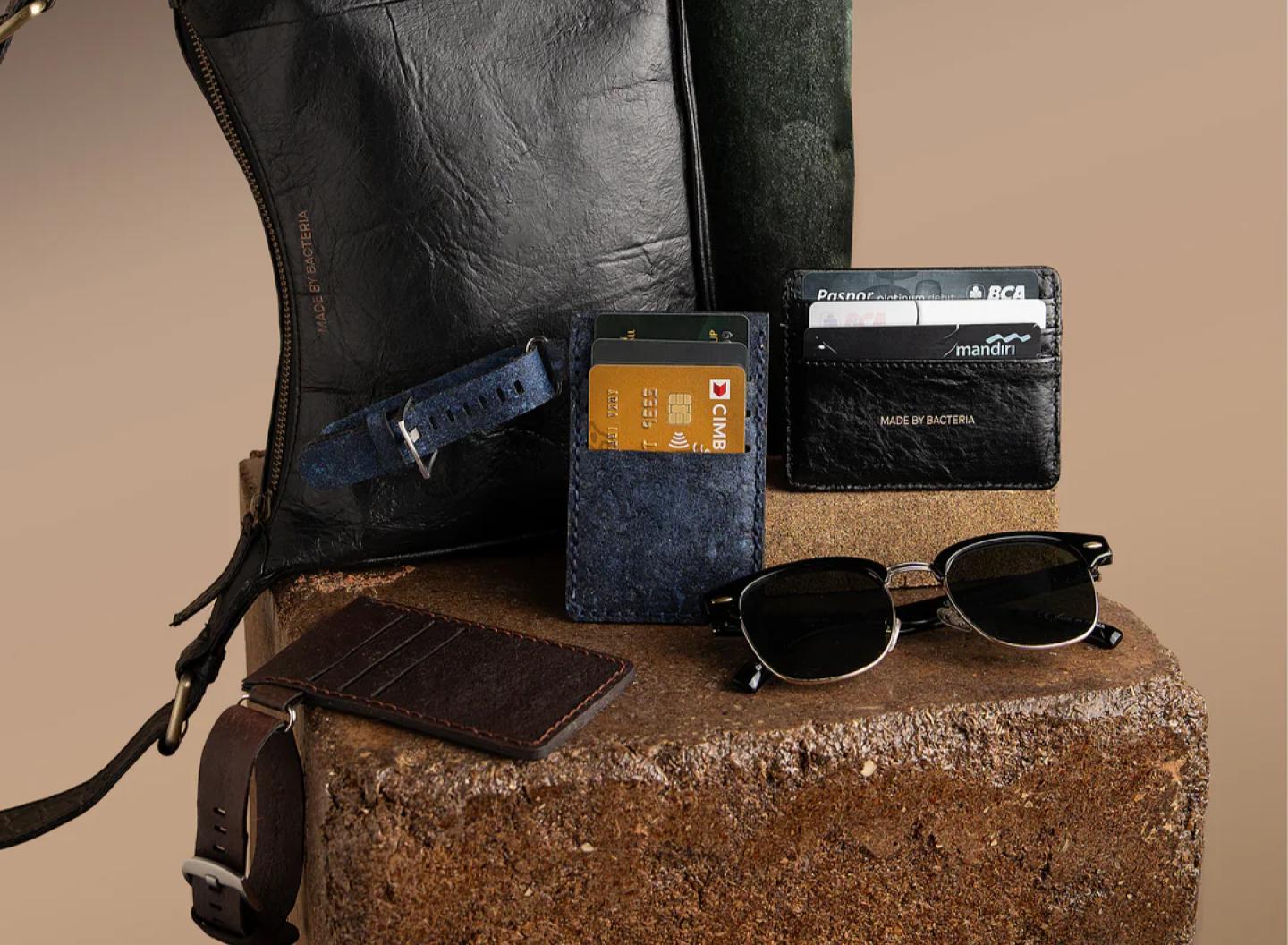
Bell Society, a startup from Bandung, Indonesia, transforms coffee pulp waste into misel, a sustainable, plant-based leather alternative created through natural fermentation. Partnering with local cooperatives, they turn agricultural byproducts into eco-friendly materials for fashion and design, offering a low-impact alternative to animal and synthetic leather.