
NEW PRODUCT / SOLUTION
Hydrocolloids, Pectin for industrial application
APPLICATION SECTOR
Cosmetics, Food and beverage
VALORIZED OUTPUT
Coffee pulp and mucilage
TRL
Deploy
CONTEXT
Global
SDG


VALUE CHAIN AREA
Coffee pulp, one of the main by-products of coffee processing, is emerging as a promising and sustainable source of hydrocolloids, particularly pectin. Traditionally treated as agricultural waste, coffee pulp is rich in carbohydrates, proteins, lipids, and insoluble fibre. In addition to offering nutritional value due to its protein and natural caffeine content, coffee pulp contains a significant fraction of pectin — a complex polysaccharide highly valued for its gelling, emulsifying, and stabilising properties in the food, pharmaceutical, and cosmetics industries.
Pectin extracted from coffee pulp has shown strong potential across various applications — from jams, jellies, and candies to emulsified products like plant-based ice creams and protein bars. It is particularly appealing in clean-label food formulations due to its natural origin and ability to extend product shelf life by retaining moisture and preventing sugar crystallisation.
Technically, pectin can be extracted using conventional methods (such as alkaline treatment followed by ethanol or aluminium chloride precipitation) or more advanced techniques like microwave-assisted extraction, which offers faster processing, lower energy use, reduced solvent consumption, and greater efficiency. Pectin yields from dry coffee pulp average around 1.81%, with some sources reporting up to 6.5%. The main sugars detected — D-galacturonic acid, galactose, arabinose, and rhamnose — are typical constituents of pectin, confirming its dominance within the soluble fibre fraction of the pulp.
Beyond food applications, coffee pulp-derived pectin shows promise in biomedical fields (e.g., wound dressings, coatings for titanium implants) and in cosmetics, where it is used in emulsions, creams, shampoos, and lotions for its emollient and stabilising properties. These versatile uses support the growing interest in revalorising coffee pulp in a circular economy approach.
Sources:
- Divyashri, G. et al. (2023) ‘Valorization of coffee bean processing waste for the sustainable extraction of biologically active pectin’, Heliyon, 9(9). https://doi:10.1016/j.heliyon.2023.e20212
- Oliveira, A. de et al. (2024) ‘Characterization and bioactivities of coffee husks extract encapsulated with polyvinylpyrrolidone’, Food Research International, 178, p. 113878. https://doi:10.1016/j.foodres.2023.113878
- Bondam, A.F. et al. (2022) ‘Phenolic compounds from coffee by-products: Extraction and application in the food and Pharmaceutical Industries’, Trends in Food Science & Technology, 123, pp. 172–186. https://doi:10.1016/j.tifs.2022.03.013
- Reichembach, L.H. and Lúcia de Oliveira Petkowicz, C. (2021) ‘Pectins from alternative sources and uses beyond sweets and jellies: An overview’, Food Hydrocolloids, 118, p. 106824. https://doi:10.1016/j.foodhyd.2021.106824
- Dong, W. et al. (2020) ‘Chemical Composition, structural and functional properties of soluble dietary fiber obtained from coffee peel using different extraction methods’, Food Research International, 136, p. 109497. doi:10.1016/j.foodres.2020.109497. https://doi.org/10.3390/foods12020423
- Abreu, T. L., Silva, G. S., de Farias Marques, A. D. J., de Espindola, J. S., de Assis, B. B. T., 466 Sampaio, K. B., de Albuquerque, T. M. R., Pacheco, M. T. B., Galland, F. A. B., de Souza, E. 467 L., Magnani, M., Madruga, M. S., & Bezerra, T. K. A. (2024). Organic arabic coffee husk: 468 Antioxidant and cytoprotective properties and potential impacts on selected human intestinal 469 bacterial populations of individuals with diabetes. Food Research International, 192. 470 https://doi.org/10.1016/j.foodres.2024.114730
- Murthy, P.S. and Naidu, M.M. (2010) ‘Recovery of phenolic antioxidants and functional compounds from coffee industry by-products’, Food and Bioprocess Technology, 5(3), pp. 897–903. https://doi:10.1007/s11947-010-0363-z
- Borrelli, R.C. et al. (2004) ‘Characterization of a new potential functional ingredient: coffee silverskin’, Journal of Agricultural and Food Chemistry, 52(5), pp. 1338–1343. https://doi:10.1021/jf034974x
- Ballesteros, L.F., Teixeira, J.A. and Mussatto, S.I. (2014) ‘Chemical, functional, and structural properties of spent coffee grounds and Coffee Silverskin’, Food and Bioprocess Technology, 7(12), pp. 3493–3503. https://doi:10.1007/s11947-014-1349-z
- WEB thesis.000000158714_20241203190247.pdf
- Liang, N. and Kitts, D. (2014) ‘Antioxidant property of coffee components: Assessment of methods that define mechanisms of action’, Molecules, 19(11), pp. 19180–19208. https://doi:10.3390/molecules191119180
- Iriondo-DeHond, A., Iriondo-DeHond, M. and Del Castillo, M.D. (2020) ‘Applications of Compounds from Coffee Processing By-Products,’ Biomolecules, 10(9), p. 1219. https://doi.org/10.3390/biom10091219.
- RPZH_2017_Vol_68_No_2_pp._115-121.pdf
- Phenolic compounds of green tea: Health benefits and technological application in food. Asian Pacific Journal of Tropical Biomedicine, 6 (8) (2016), pp. 709-719, 10.1016/j.apjtb.2016.06.010
DESCRIPTION


IMPACTS


Although coffee pulp offers excellent potential as a source of pectin and other valuable compounds, turning it into a scalable industrial resource is not without obstacles. Its composition can vary a lot depending on the coffee variety, the ripeness of the cherries, and how they are processed after harvest, all factors that can affect the quality of what is extracted. There are also strict food safety and regulatory requirements to consider if the final product is meant for human consumption. Another issue is seasonality: since coffee pulp is only available during harvest times, ensuring a steady supply year-round can be tricky unless production is based near large growing areas. On top of that, while some extraction methods are effective, they can be expensive or complicated to scale. Finally, there is the question of perception, consumers may still be hesitant about by-products unless there is a strong communication effort around their safety, quality, and sustainability.
CHALLENGES AND LIMITS

EXAMPLES OF APPLICATION
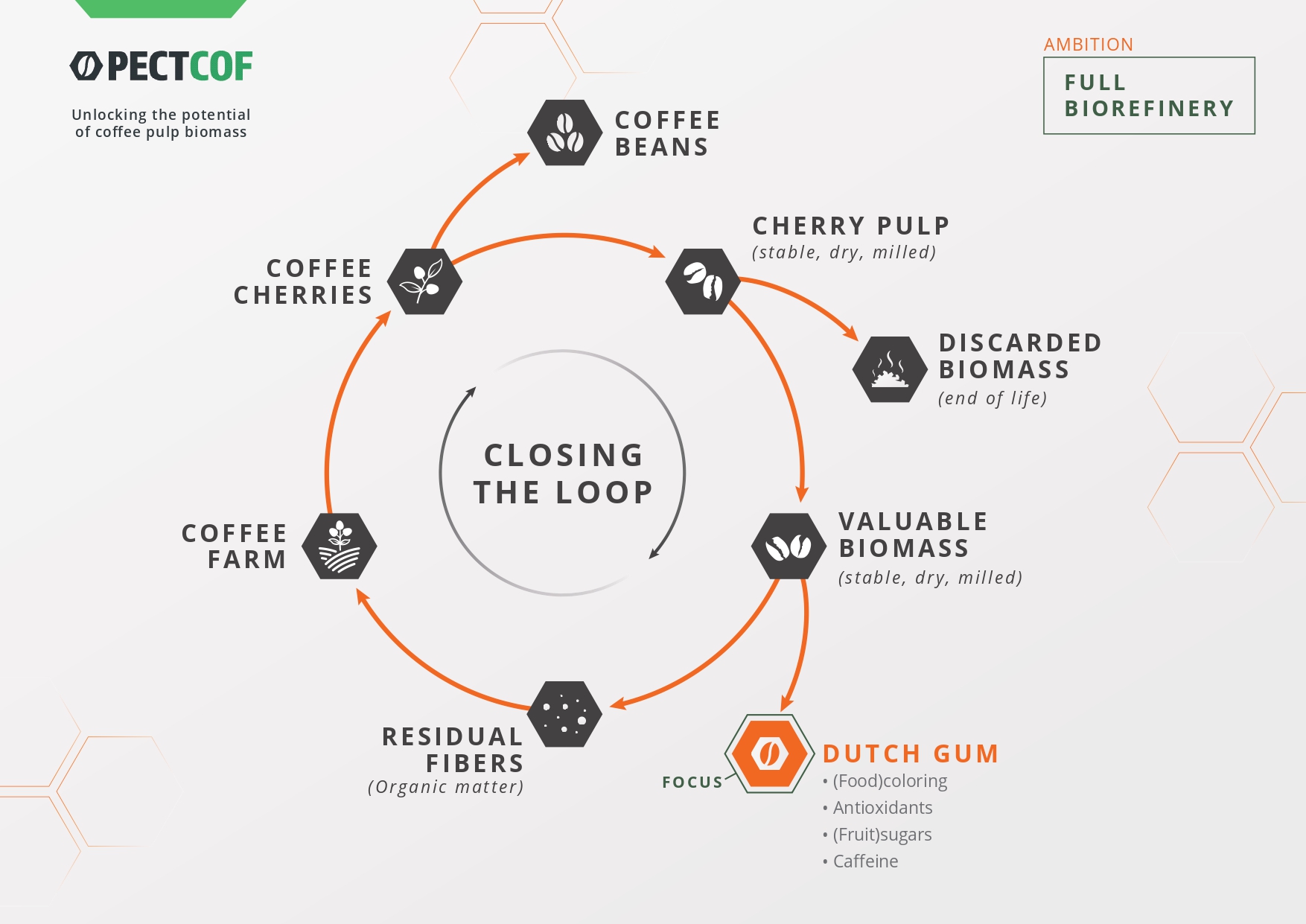
Dutch Gum® is a product by Pectcof that ensures a quality gum food additive (hydrocolloid). The additive contributes to offset the bitter taste and off tastes in common plant-based products. The pectin from the coffee cherry has a high-water binding capacity to extend the shelf-life of high protein products, it also reduces sugar crystallization, meanwhile enhances nutty or fruity notes.